Tuesday, September 27, 2016

The Destructive Impacts of Corporate Mining in the Philippines: The Tampacan Copper-Gold Mining Project in Mindanao

The Destructive Impacts of Corporate Mining in the Philippines: The Tampacan Copper-Gold Mining Project in Mindanao

Désastre humanitaire aux Philippines. Dans la cruelle foulée de la tempête tropicale Ketsana
The Philippines has an estimated $840 billion worth of untapped mineral resources, according to the Mines and Geosciences Bureau of the Philippines which is responsible for giving permits to mining companies to do exploration of mining areas and to commence operation. Small-scale mining industries have contributed to national revenues.
A big problem ensued with the signing of the Philippine Mining Act of 1995 authored by then Senator Gloria Macapagal Arroyo which allowed 100% ownership of the claimed mining land area and minerals by foreign multinational mining corporations. Large-scale mining is destructive as it uses the method of open-pit mining which entails clearing thousands of hectares of rainforests and agricultural lands, deep excavations to extract minerals, the use of toxic heavy metals and chemicals to process mineral ores, and the consumption of millions of liters of water – all of which negatively impact the lives of the Filipino citizens with the grave disregard for their right to health, life, food security, livelihood, and a clean environment. This is the social justice issue of large-scale mining. Large-scale mining is against the sustainability of the environment and of the people’s cultural identity and quality of life. 
Corporate mining permits multiplied under the administration of President Benigno Aquino III in the belief that large-scale mining tax revenues would spur economic growth. However, environmentalists blame the liberalized mining sector for the greater destructiveness of natural disasters in the country. According to Marya Salamat of bulatlat.com (2013), environmentalists blame mining companies for contributing to massive siltation of the rivers, poisoning the waterways and agricultural fields with toxic chemicals and rendering communities more vulnerable to flooding. At the same time, local communities affected by mining bewail the loss of their former livelihood in fishing, agriculture and forestry, “as some of them were forced to become mineworkers instead, or service workers for those at work in the mines, including some women becoming prostitutes, reportedly driven to it by the combination of their family’s loss of land, livelihood and influx of men working in the mines” (Salamat, 2013).
Tampakan Mining (Mining Journal)
Tampakan Mining (Source: Mining Journal)
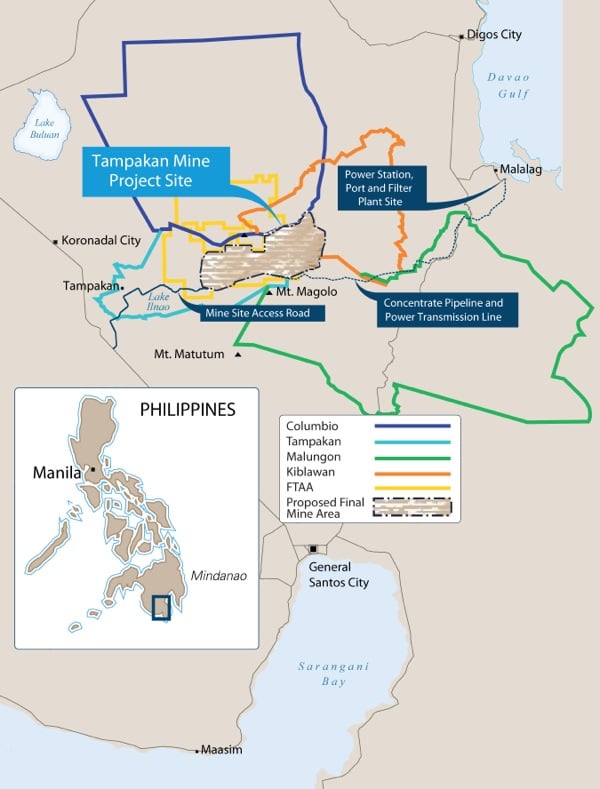
If realized, the proposed Tampacan copper-gold mining project by the Sagitarrius Mining Incorporated in South Cotabato, Mindanao would be the largest open-pit mine in the Philippines and one of the largest of its kind in the world. The open pit would reach an extent of 500 ha and a depth of 785 meters while the topsoil stockpile would cover an area of 5 ha and the pit ore stockpile 49 ha, according to conservation and development consultants like Clive Montgomery Wicks. On February 2013, the Mines and Geosciences Bureau under the Department of Enviroment and Natural Resources issued an Environmental Compliance Certificate to SMI. But various civil society groups and church leaders strongly oppose the Tampacan copper-gold mining project because of its disastrous impact to the environment, to the watershed area spanning three major rivers in Mindanao, to agricultural production, and to the displacement of 5,000 people living in the area where the proposed mining will be done.
Source: Mining.com
The sad and unfortunate concomitant to the struggle against the Tampacan copper-gold mining project is the lack of in-depth analysis of most mainstream media news on the issue, and instead of providing an assessment of the impacts vis-à-vis the alleged benefits from the mining project, tend to provide news on the corporate affairs of the multinational corporations which have interest on this project. In contrast, alternative media like bulatlat.com and davaotoday.com provide news reports with in-depth analysis of the mining situation and show the alternative viewpoints of those who are against the mining project. In 2012, Bulatlat.com reported on what has not been reported by the mainstream media: the massacre of a B’laan family whose head declared a tribal war against SMI. Davaotoday.com reported on the Catholic Bishops’ plea to President Aquino to stop the Tampacan mining project on strong moral grounds. Civil society groups which are against the Tampacan mining project such as Kalikasan Peoples’ Network for the Environment, Alternative Forum for Research in Mindanao, Center for Environmental Concerns, and international non-profit, cause-oriented organizations such as War on Want, London Mining Network, Banktrack, and Indigenous Peoples’ Link have posted press releases, investigative reports, and analytical articles on the destructive impact of the proposed large-scale mining project and expressed a clear, strong opposition to the proposed mining project.
The proposed mining project straddles the jurisdiction of two regions, four provinces, four municipalities, and nine barangays. If this mining project will be realized, its environmental cost and negative impact to the livelihood, health, and quality of life of the Filipinos living in affected areas in four provinces of Mindanao (South Cotabato, Sarangani, Sultan Kudarat, and Davao del Sur) will be immense and incalculable, to say the least. The open pit will not be back filled, and according to Dr. Godilano (2012), the billions of tons of acid forming waste rocks and mine tailings that the mining corporation will leave behind will require management in perpetuity. According to the Catholic Church in South Cotabato, if Sagittarius Mines, Inc. (SMI) will be allowed to operate, it will destroy the environment by massive clearing of 6,935 hectares of rainforests and agricultural lands, contaminate three major watersheds (ridge-rivers-reef) for five provinces, and dry up the irrigation systems in the lowlands and the aquifers in General Santos and Koronadal City. It will result to the dislocation of almost 6,000 surface dwellers, mostly B’laans, from their ancestral land, and has actually led to human rights violations with the killing of anti-mining indigenous people and activists and the restrictions of access by the indigenous people to the forests and agricultural lands claimed by the mining corporations.
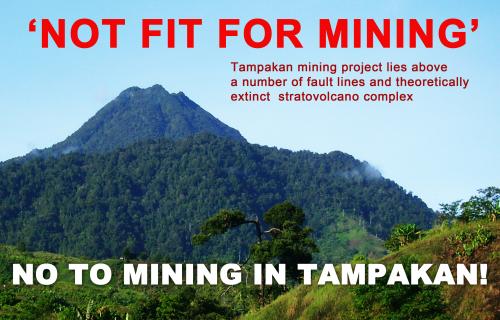
In addition, it impacts negatively the people’s health, safety, food security and right to life and livelihood by the constant risk of breakage of the dam that will hold the mine tailings and the contamination of water, soil, and air by toxic chemicals and heavy metals that will be used for processing the mineral ores from the mining area in Tampacan. The added risk is that the Tampacan mining area sits on fault lines, which increases the risk of seismic activity that poses threat to the spilling of the dam for mine tailings and the contamination of flood waters with toxic mine wastes due to the deforestation of the area, soil erosion, and siltation of rivers, which further aggravate and are aggravated by climate change.
Because of these huge environmental, social, and cultural costs, allowing the SMI to operate tantamounts to a betrayal of the Philippine nation and of the Filipino people because no amount of taxes that will be obtained from SMI can compensate for the environmental destruction and long-term negative impacts on the health, food security, and right to life and livelihood of the Filipinos in five provinces of Mindanao- South Cotabato, Sarangani, Sultan Kudarat, Davao del Sur, and Maguindanao – and the cities of General Santos and Koronadal. The promises made by the mining company to provide scholarships and provide livelihood to the affected people, especially the indigenous B’laan tribe, are mere palliatives in comparison to the massive environmental destruction and long-term negative impacts of this proposed large-scale mining project.
The government must listen to the cry of the Filipino people to stop the Tampacan mining project. The Philippine Mining Act of 1995 which allows for 100% ownership of mineral ores and land covered in the claimed mining area should be repealed because it is against national sovereignty and against sustainability of the environment, cultural identity, quality of life, and livelihood of the Filipinos that will be most affected by the large-scale mining projects. President Benigno Aquino should learn to adopt the principles of sustainable development, repudiate neoliberal economics which is pro-corporate profits and breeds grave inequities in the world, and repudiate the impositions of World Bank, World Trade Organization, and International Monetary Fund.
Citizens who understand the situation must shout together the protest against the evils of neo-liberal capitalism exemplified by large-scale, corporate mining and must put a stop to the desecration of nature and the violation of human rights of the poor and the indigenous peoples of the Philippines and other developing countries.
Credits: http://www.globalresearch.ca/the-destructive-impacts-of-corporate-mining-in-the-philippines-the-tampacan-copper-gold-mining-project-in-mindanao/5436594

DENR stops mining in ARMM for new audit

DENR stops mining in ARMM for new audit

Nash B. Maulana, Inquirer Mindanao | 02:19 AM July 15th, 2016

COTABATO CITY—The Department of Environment and Natural Resources (DENR) in the Autonomous Region in Muslim Mindanao (ARMM) has suspended all mining operations in the region.
The move came in the wake of an audit of all mining operations ordered by Environment Secretary Gina Lopez.
President Rodrigo Duterte has taken a tough stance against what he said was irresponsible mining that has destroyed the land but did not benefit the people
The ARMM office of the DENR issued the order after Gov. Mujive Hataman, who won reelection, issued a policy statement on mining when he assumed office on June 30.
Hadji Kahal Kedtag, ARMM environment secretary, said the order to suspend mining in the region was released on July 12 after the DENR office in ARMM finished organizing a task group to conduct a performance audit of mining firms and review permits issued for mining operations.
Executive Order No. 79, issued by Hataman, outlines reforms in the mining sector and provides guidelines for environmental protection in mining operations.
The ARMM has been empowered by its charter and mining laws to issue mineral production sharing agreements (MPSAs).
Among the companies issued MPSAs by the ARMM government are Dasussalam Mining Co., Al Tawi-Tawi Nickel Group, Singcara Mining and Development Corp., Pax Libera Mining Inc., Chan C. Mining and Hikanjay Mining Inc. The companies operate in Tawi-Tawi province.
These, and other mining firms in ARMM, are required to prove compliance with laws governing environmental protection, relationship with communities affected by mining and rehabilitation of mined out areas.
Failure to do so, said Kedtag, would lead to the closure of the companies.
On orders of Hataman, the DENR office of ARMM sent members of the task group to Tawi-Tawi that include officials of the regional DENR office and representatives of civil society groups.
They would conduct a monthlong audit of mining firms’ compliance with responsible mining requirements.
Lawyer Randolph Parcasio, a former consultant for the United Nations Development Program, leads the task group.

Massive Minings in the Philippinnes

DENR spares 11 firms in massive mining audit

Danny Jovica, file
MANILA, Philippines -- The government has spared only 11 companies of the country’s 41 operating metallic mines as the Department of Environment and Natural Resources (DENR) released the results of its audit aimed at putting an end to irresponsible operations in the Philippines.
 
In a briefing Tuesday, Environment Undersecretary Leo Jasareno, head of the mining audit team, said only 11 did not get recommendations for suspension while 20 will be given seven days to address the audit findings. Operations of the 10 companies earlier suspended will remain suspended.
 
“So far, we have suspended 10. Eleven passed the audit and 20 need to get their acts together,” Environment Secretary Gina Lopez said.
 
Among mining operations spared are:
 
  • Pangilinan-led Philex Mining Corp. 
  • Nickel Asia Corp.'s Rio Tuba Nickel Corp., Cagdianao Mining Corp. and Taganito Mining Corp. 
  • Atlas Consolidated Mining and Development Corp.
  • Techiron Resources Inc.
  • Platinum Group Metals Corp.
  • Philsaga Mining Corp.
  • Greenstone Resources Corp.
  • Apex Mining Co. Inc.
  • Pacific Nickel Philippines Inc.
 
“They are running their operations much better than the others. However, in efforts to get better, even if they passed, I still want to talk to them and push them a little better,” Lopez said.
 
Meanwhile, companies that are on the verge of total suspension include:
 
  • Lepanto Consolidated Mining Co.
  • MarcVentures Mining and Development Corp.
  • OceanaGold Philippines Inc.
  • Filminera Resources Corp.
  • Strongbuilt Mining Development Corp. 
 
Meanwhile, AAMPhil Natural Resources Exploration and Development Corp.,  Adnama Mining Resources Corp., Minimax Mineral Exploration Corp., Carrascal Mining Corp., Century Peak Corp. and CTP Construction and Mining Corp. have been asked to respond to the DENR's audit findings.
 
The DENR will also suspend:
 
  • SR Metals, Inc.
  • Hinatuan Mining Corp.
  • Wellex Mining Corp.
  • Krominco Inc.
  • Libjo Mining Corp.
  • Norweah Metals and Minerals Co. Inc.
  • Oriental Synergy Mining Corp.
  • Sinosteel Phils HY Mining Corp. 
 
Jasareno said majority of the reason for suspension of the companies include discoloration due to siltation, soil erosion, lack of social development and rehabilitation projects, destruction of the forest, no tree cutting permits and inadequate preventive measures on the mining areas. 
 
Mining companies involved are yet to issue their official statement regarding the department’s recent orders. 
 
As most of the mines eyed for suspension are nickel mines, Jasareno said it constitute 55.5 percent of the country’s total nickel production value based on last year’s data. 
 
The 20 mining companies will be given seven days to answer and then a final decision will be made.
 
“Each mine will be provided a report. They will be given one week to respond then the department will review their explanation once we receive them,” Jasareno said.

Chamber laments findings

On the other hand, the Chamber of Mines of the Philippines (COMP) decried the mine audit results which recommended for the suspension of eight of its members which include Filminera Resources Corp., Marcventures Mining and Development Corp., Agata, CTP Construction and Mining Corp., Hinatuan Mining Corp., Benguet Corp., Lepanto Consolidated Mining Corp. and OceanaGold Philippines Inc.
 
The Chamber lamented how the whole mining audit was done in a punitive manner rather than objectively. 
 
“When you suddenly change the rules of the game, there should have been an earlier dialogue between companies and the DENR given that the audit report was already finished in August. As early as August, the alleged violations could have already been addressed instead of setting a trap for suspension,” COMP Vice President for Policy Ronald Recidoro said. 
 
Since the start of the audit, 10 mining firms had been suspended including all operations in Zambales – Benguet Corp. Nickel Mines Inc., Zambales Diversified Metals Corp., LNL Archipelago Minerals Inc. and Eramen Minerals Inc. – for breach of environmental standards.
 
Other firms that were suspended include the country’s only iron-producing mine Ore Asia Mining and Development Corp., Samar-based operations Mt. Sinai Exploration Mining and Development Corp., EMIR Mineral Resources Corp., Berong Nickel Corp., Claver Mineral Development Corp., and Citinickel Mines and Development Corp.
 
Lopez reiterated that any decision that the department will make will be based on what is best for the greater majority.
 
“Resources of the country must be utilized in a way that benefits the greater majority. I want the DENR to be not regulatory but developmental,” she said.
 
“I’m not against mining. I’m vehemently against the adverse effect that may happen and are happening. I want us to be better than Canada and Australia,” Lopez added. 
 
While some miners questioned the mining audit process, Jasareno emphasized that it was a compliance to the directive of President Rodrigo Duterte himself to determine adequacy and efficiency of environmental protection measures; identify gaps in environmental protection measures; and determine penalties in case of violations.
 
The audit team was composed of the DENR central and regional offices, Mines and Geosciences Bureau, Environmental Management Bureau, third part experts including the Departments of Health and Agriculture and civic society organizations. 
 
The audit’s checklist focused on safety and health, mine environmental management, social development, mining tenement, Clean Air Act, Clean Water Act, Hazardous Waste and Solid Waste.
 
Next month, the DENR will start the audit of 65 operating non-metallic mines.

Credits: http://www.philstar.com/business/2016/09/27/1627967/denr-spares-11-firms-massive-mining-audit

Monday, September 26, 2016

Philippine Minings

9 things you need to know about mining in Philippines

The mining industry in the Philippines is controversial again as the Aquino government issues a policy and pursue legislation on a potentially economically rewarding extractive business but a flashpoint for environmental and other stakeholder groups
Leilani Chavez
Published 3:34 PM, September 07, 2012
Updated 3:34 PM, September 19, 2012
MANILA, Philippines - The mining industry in the Philippines is controversial again as the Aquino government issues a policy and pursue legislation on a potentially economically rewarding extractive business but a flashpoint for environmental and other stakeholder groups.
Below is a list of 9 key things to know the mining industry in the Philippines:

1. The Philippines is the fifth most mineral-rich country in the world for gold, nickel, copper, and chromite. It is home to the largest copper-gold deposit in the world. The Mines and Geosciences Bureau has estimated that the country has an estimated $840 billion worth of untapped mineral wealth.

2. All the regions (except NCR and ARMM) in the country allow mining operations. ARMM ceased issuing permits due to the on-going peace process between the Moro Islamic Liberation Front and the national government.

3. About 30 million hectares of land areas in the Philippines is deemed as possible areas for metallic minerals. Of these, only a small percentage has been covered by present mining permits.

4. The Philippines metal deposit is estimated at 21.5 billion metric tons and non- metallic minerals are at 19.3 billion metric tons.

5. Labor department statistics show that mining in the Philippines has created 211,000 jobs in 2011 alone. The figures have doubled since 2006.

6. The mining industry's gross production value has consistently increased through the years. In 2010, the mining industry reached $3.2 billion.

7. The Mining Act of 1995 allows for foreign ownership of mining assets and exploration permits. The Supreme Court upheld the constitutionality of the foreign investors' participation in mining activities in 2004. 

8. Mining tax is low at 2% for metallic and non-metallic minerals. The current Aquino administration, however, wants to increase revenues through an additional 5% royalty tax for mining permits within mining reservation areas and increase the filing fee charges.

9. There are a total of 1,828 mining applications in the country, which will be directly affected by the Executive Order from the Aquino administration that does not allow new mining permits. 
Credits-Rappler.com